Skip navigation

Category Archives: birds

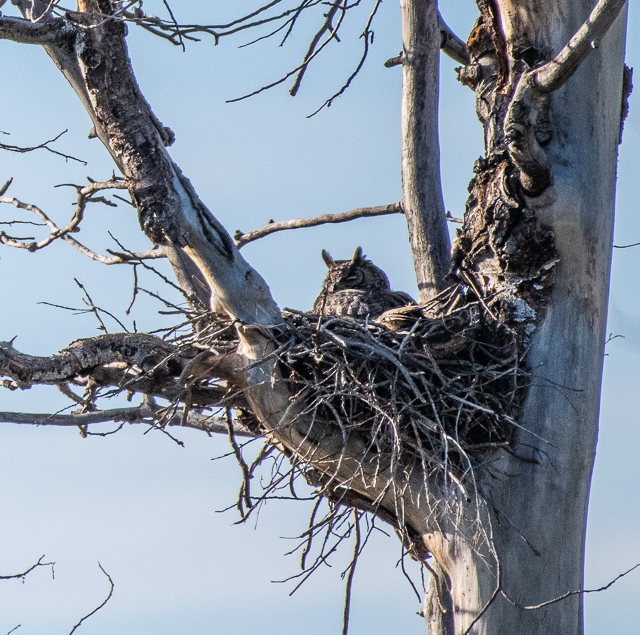
These two Great Horned Owls kept us awake earlier in the spring with their hooting back and forth in the wee hours of the morning. Now that they’ve settled down to raise a family, they are much quieter. I imagine they are busy hunting, probably just one at a time these days. I think the eggs have hatched and the mom stays on or near the nest all the time while the dad stands guard in a nearby tree during the day. It will be fun to watch the little ones grow up!


As the days grow warmer, new birds migrate to the nesting areas and begin setting up their territories, declaring them from tree tops, fence posts and signs. During yesterday’s early morning walk, I heard bluebirds, sparrows, finches and meadowlarks. Owls wake us up at night with their hooting. There is so much to see and hear!

Here is the song of the Western Meadowlark from the Cornell website.

My birthday is the first day of Spring – the Equinox – and I like to celebrate it out in nature. This year the snow lingers most everywhere in our region making hikes or even long walks pretty challenging. So we went down to the big river – the Columbia – where the temperature is more moderate and the snow melts more quickly. Still, there was snow on the ground. Not everywhere so we all were happy to walk or in the dogs’ case, run on ground for a change. And Sky got to jump in the river so all of her wishes came true.

Ken and I watched birds and enjoyed the diversity of species we got to see. Sometimes in winter there are just not many birds around. Spring and migration change all that. We saw over fifty species in a few hours of birding. That includes the birds at home. One of those was a Great Horned Owl that woke me up before dawn, hooting from a snag in our yard. I had hoped to maybe see Sandhill Cranes but it seems that they are put off by all the remaining snow. I imagine when they do head north, they won’t stop here very long since they need to get to their nesting grounds. We did see lots of ducks and geese and swans too.

This winter birders are observing many Varied Thrushes in North Central Washington. These birds are closely related to American Robins – same general size and shape but with some very distinct markings. We counted quite a few on the Christmas Bird Count around Twisp. More than usual although it is an expected species in the winter.

Saturday in Twisp, I noticed lots of them in the crabapple trees in the park. They would fly if I walked but if I stayed in the car I could photograph them for as long as I wanted. The bird with the gray band across its chest is a female and the one with the black band is a male.

American Kestrels are the smallest falcons in North America. This tiny raptor has a wingspan of 22 inches and weighs 4.1 ounces. It eats small mammals, insects and today it ate a finch from our feeder. This bird is a male because of the blue on its wings. It was minus four this morning before the sun came out. Normally this bird has a sleek appearance but it fluffed its feathers in order to keep warm.