Skip navigation

Tag Archives: birding

Yesterday we went birding. We made a big loop around Okanogan County, crossing the mountains between the Methow and the Okanogan, up on the plateau on the east side of the county, and then down to the big river (Columbia) and back up the Methow. During the day we saw over sixty species of birds, two coyotes, one beaver and three pronghorns! This was my first time seeing pronghorns in Washington. The Colville Tribes have re-introduced them on their lands and the animals have quickly spread with reports of them across the Columbia in Douglas County. I wonder if they swam or crossed a bridge. Do pronghorns swim?

As for birds, I was disappointed that we didn’t see more little birds and also cranes. I often see Sandhill Cranes in March. I’ll have to try again soon. The landscape was drier than usual. Normally roads are pretty muddy with more snow on the ground. The weather was perfect. I think it must have been sixty degrees down on the big river.

As for social distancing, we did not talk to other people or go into any businesses.

This little Northern Saw-whet Owl may have thought otherwise. Ken wanted to see if we could find them so I told him to watch for white wash under dense trees and if he did, he should look up. Sure enough, it worked and he found this tiny owl tucked up in some branches pretty well hidden. It was very hard to photograph.

Yesterday’s bird list for the whole day:

Canada Goose

Swan sp

Gadwall

American Wigeon

Mallard

Northern Pintail

Green-winged Teal

Canvasback

Redhead

Ring-necked Duck

Lesser Scaup

Bufflehead

Common Goldeneye

Hooded Merganser

Common Merganser

Ruddy Duck

California Quail

Ring-necked Pheasant

Wild Turkey

Pied-billed Grebe

Horned Grebe

Rock Pigeon (Feral Pigeon)

Eurasian Collared-Dove

Mourning Dove

American Coot

Killdeer

Common Loon

Double-crested Cormorant

Great Blue Heron

Golden Eagle

Sharp-shinned Hawk

Cooper’s Hawk/Northern Goshawk

Bald Eagle

Golden/Bald Eagle

Red-tailed Hawk

Northern Saw-whet Owl

Belted Kingfisher

Northern Flicker

American Kestrel

Say’s Phoebe

Black-billed Magpie

American Crow

Common Raven

Black-capped Chickadee

Horned Lark

Tree Swallow

Violet-green Swallow

Pygmy Nuthatch

European Starling

Western Bluebird

Mountain Bluebird

American Robin

House Sparrow

House Finch

American Goldfinch

Dark-eyed Junco

White-crowned Sparrow

Song Sparrow

Spotted Towhee

Western Meadowlark

Red-winged Blackbird

Brewer’s Blackbird

Yellow-rumped Warbler

Two Hairy Woodpeckers were chasing each other around the snags and feeders yesterday. I think it was a bit of a territorial dispute. Spring is in the air, after all.

On the weekend of June 1, I visited my friend Betty for a long weekend of birding. North Central Washington Audubon Society hosted a big day on June 1, in hopes of counting all or many of the birds in our four-county (Chelan, Douglas, Ferry and Okanogan) area. It’s a HUGE geographic area. And much of it is remote and lightly populated with people.

Betty lives in Ferry County, the area with the fewest people and lots of really nice bird habitats. I birded my way over there on Thursday; Friday we scouted our area and visited a friend in the next area; Saturday we marathon birded from early in the morning til well into the evening and Sunday I worked my way home slowly til it got too hot to be any fun. We had some rain and once it came down in such a downpour we were concerned for our safety and decided to make a hasty departure. There was hail and lots of sunshine too. Somehow I managed to only photograph birds and not Betty or the dogs or the horses or chickens. Looking forward to next time!

I’ve been visiting Lost Lake for nearly twenty years now. From the first time, I remember the loons. It was news to me that there were Common Loons in Washington. And then I realized that they were nesting here too!

Lost Lake is a small lake so it only hosts one nesting pair. There are a few other lakes in eastern Okanogan County and also in Ferry County that support a small population of nesting loons. Loons face many obstacles to raising their babies. Both parents take turns on the nest so the eggs (often there are two) are never left exposed. Predators that could take them include Bald Eagles, Common Ravens and otters. After they hatch and the young birds are on the water, the parents are constantly wary of attacks from the air and the water. An eagle can easily take a young loon from the water’s surface.

Loons aren’t the only birds at Lost Lake but they might be the most charismatic. Lots of people fish there in non-motorized boats so the birds are accustomed to boats and will approach fairly close. They are especially interested in the anglers. I find that if I sit quietly in my kayak, the birds will come close and offer great looks. Not that close though. These photos were mostly made with a 600 mm lens. The forest bird photos were made with a much shorter lens.

Spotted Sandpipers are a real joy to watch. They trot along logs and sticks on the water, bobbing their tails up and down and issuing their calls when they fly to the next lot. There are lots of swallows around the lake, taking advantage of many of the cavities in the trees for nesting sites.


Birding always brings something interesting. Sometimes when we go with expectations of seeing something in particular, our hopes are dashed when we miss it. But the search is always fun. Yesterday we went down to the Columbia River where it was warm and spring-like. Despite the warm temperature we did not see any swallows or bluebirds which have already made an appearance at my house. The water was calm and glassy giving us a beautiful background for the numerous waterfowl we observed. They are all in their spring plumage and the colors are brilliant in the strong sunshine – mallards, goldeneyes, canvasbacks and many more species were seen. We saw nests of Common Ravens and also Great-horned Owls. Bald Eagles, Northern Harriers and Red-tailed Hawks were paired up and some were cavorting in flight! We heard the songs of a Bewick’s Wren and a Ruby-crowned Kinglet. Western Meadowlarks sang in several locations.

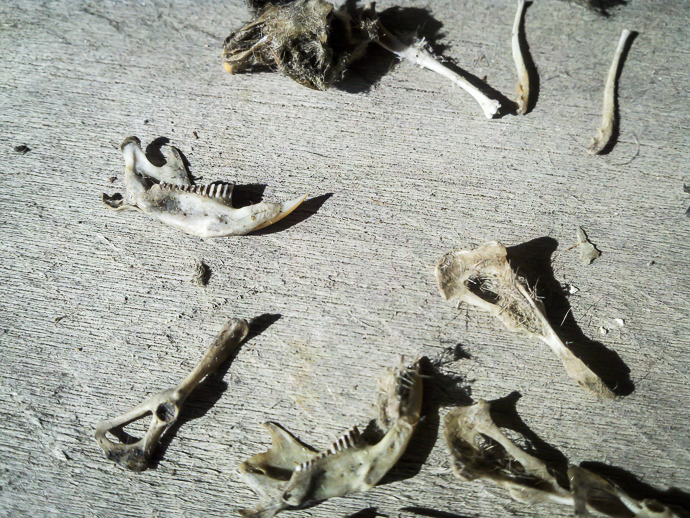
We did have a target bird yesterday – Northern Saw-whet Owls. People have observed as many as five of them in the state park and we even knew which campsites to search for them. Unfortunately the state park staff was engaged in clean up with noisy machines – leaf blowers and leaf vacuums. We picked the group site to begin our search, as far from the machines as we could get. Two big evergreens seemed like likely candidates to shelter these tiny owls. We found the white wash we were looking for and even found pellets but could not spot a small owl. We began to take apart the pellets (a pellet is the part of the meal that is undigestable and is regurgitated onto the ground, usually composed of bones and fur) to entertain ourselves, making a tidy display of teeny little bones on a board.

Having had enough of fur and bones, we moved on to the rest of the campground despite the machinery. After a while I tired of that but Juliet kept looking while I went to the riverbank to see what I could see. I caught up with her at the last area, nearest where we had left the car as she was searching intently high in a dense tree with her binoculars. She said, it has to be here; look at this big white wash! I stood there and looked straght up into the tree and what did I see? A bird butt! I moved around and sure enough, there it was, a tiny Northern Saw-whet Owl looking down at me.


Small mammal bones

2013-03-11_15-18-20_257-2


These bones are tiny. The jaw bone on the left is maybe half an inch long.

2013-03-11_15-18-31_914-2


Small but ferocious

031113_0124


The owl was more interested in people farther away than us immediately under it.

031113_0139


It wanted us to leave so it could go back to sleep.

031113_0146


This is a Double-crested Cormorant skull, one of two that we saw on the riverbank.

2013-03-11_11-50-05_438-2