Skip navigation

Tag Archives: birds

After two years of lower than average snowfall, this season we are happy to see lots of snow on the ground with more on the way. We rang in the New Year with below zero temperatures and clear skies and glimpses of northern lights. I enjoyed time with our friends and did not try to get photos on that frigid night!

The skiing on groomed trails is wonderful and up until this week, skiing in the hills and backcountry has been marvelous! It made me wish I had some more rugged skis with skins for climbing the hills. A few days ago the temperature warmed over thirty degrees and it felt downright balmy at 34° Fahrenheit.  Of course, that sort of ruined the two feet of powder snow, leaving a one inch crust on top of it. It makes it very hard to get around once you are off the beaten path. Even for dogs but Sky seems to manage.

Speaking of dogs, Luna had to have surgery last week to remove a cracked tooth and an unusual growth on her side. The growth is benign so we can quit worrying about that. Whew. She has had to be less active and is missing her dog friends and skiing at Big Valley but the stitches need to time to heal. Hopefully in another week or so she can resume her regular fun activities.

Winters can be hard on the native birds so we put out black oil sunflower seeds, nyger seeds and suet for the songbirds. That also attracts raptors like hawks and kestrels who might try to take advantage of the situation. We figure that they all need to eat and are happy to see the diversity of species.

Common Redpolls are an uncommon species in our area. If they do arrive here, it’s in the coldest part of the winter and they are attracted to our feeders. Some years I don’t see them at all. Last year was one of those years. This winter there is quite a flock of them coming daily to munch on black oil sunflower seeds and niger seeds. I’ve also seen them eating privet berries. They now outnumber our more commonly observed American Goldfinches, House Finches and Pine Siskins. They seem like jaunty little birds with their red crowns and the males’ pink breast.

According to Bird Webthey are arctic and sub-arctic breeders and in the winter they inhabit various kinds of semi-open country, including woodland edges and brushy or weedy fields.” Also, “they have pouches in their throats that allow them to gather large amounts of food quickly, and then retreat to a safe place to process the food. In winter, they will drop from a tree into deep snow and make a tunnel about a foot long to a roosting chamber.” I would love to find their tunnels!

There was a nice morning walk with the dogs. I saw quite a few bird species – the most so far this spring. Here is the list:

Canada Goose
Mallard
Dusky Grouse
Northern Harrier
Red-tailed Hawk
Mourning Dove
Rufous Hummingbird
Hairy Woodpecker
Northern Flicker
Pileated Woodpecker
Say’s Phoebe
Black-billed Magpie
Clark’s Nutcracker
Common Raven
Tree Swallow
Violet-green Swallow
Black-capped Chickadee
Mountain Chickadee
Pygmy Nuthatch
Western Bluebird
American Robin
European Starling
Spotted Towhee
Brewer’s Sparrow
Dark-eyed Junco
Red-winged Blackbird
Western Meadowlark
Cassin’s Finch
Red Crossbill
American Goldfinch

Then a brief stop at a yard sale and a walk through Winthrop looking for images.

Vieques, like many other islands around the world, has been plagued by non-native animals introduced for one reason or another. The human population is less than 10,000 and the horse population is around 3,000. Many of these horses are feral and some are perhaps simply let out to graze til their owners decide they need them. More people appeared to ride horses than bikes. Chickens are everywhere. Their incessant crowing woke me up at night. Dogs and cats are allowed to roam and most do not appeared to be neutered. I was disappointed with the lack of birds – both in numbers of birds and diversity of species. It may be a slow time with many having migrated away for the ‘winter’ season however I was told that there are never a lot of birds, certainly nothing like Florida. Even sea birds which would presumably not be affected by the introduced species on the island, were few and far between. Frogs, toads and lizards were everywhere. At night the frog sounds provided a white noise for sleeping. I named one frog the marimba frog due to its call that sounded like marimba notes. Another tiny frog says its name ‘coqui’. We saw one bright green iguana on the west end of the island. These were introduced for a reason that I don’t know.

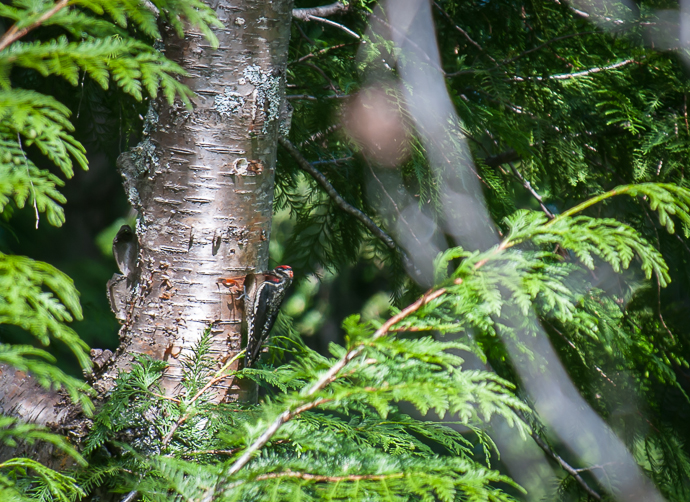
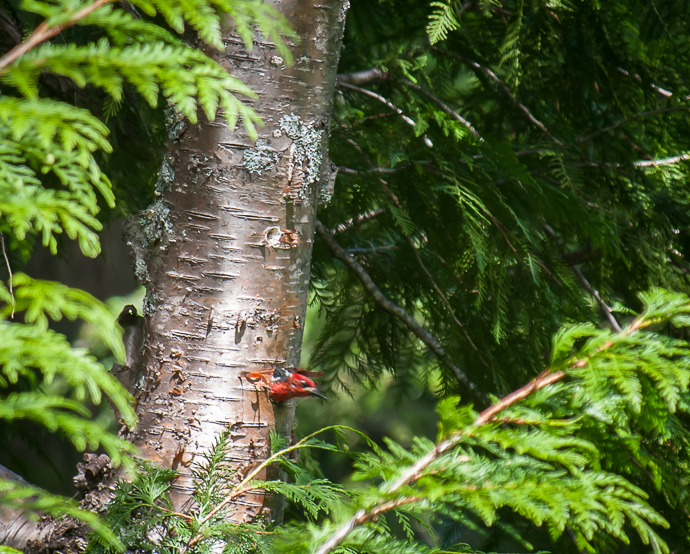
What happens when two birds of different species get together and make a nest? Hybridization. According to an article by Kim Romain-Bondi in North Central Washington Audubon Society’s newsletter, The Wild Phlox, “these two species are sympatric, meaning that during the evolution process, they became two new species while inhabiting the same geographic region. Generally speaking in Washington, the Red-breasted live on the west side, the Red-naped on the east side of the Cascades……. These two species of sapsuckers are known to hybridize in south-central Oregon, northeastern California, along the California-Nevada border, and in southern Nevada.”

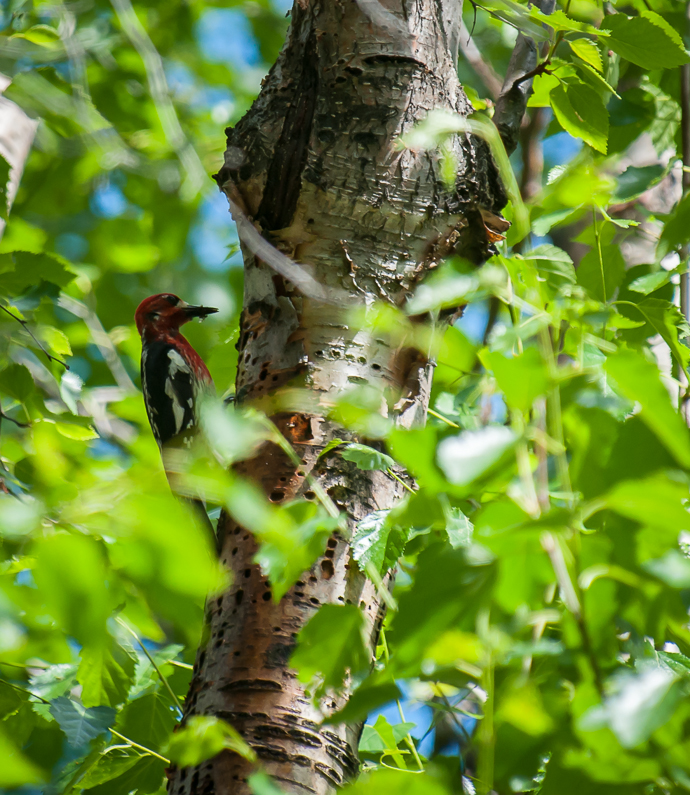
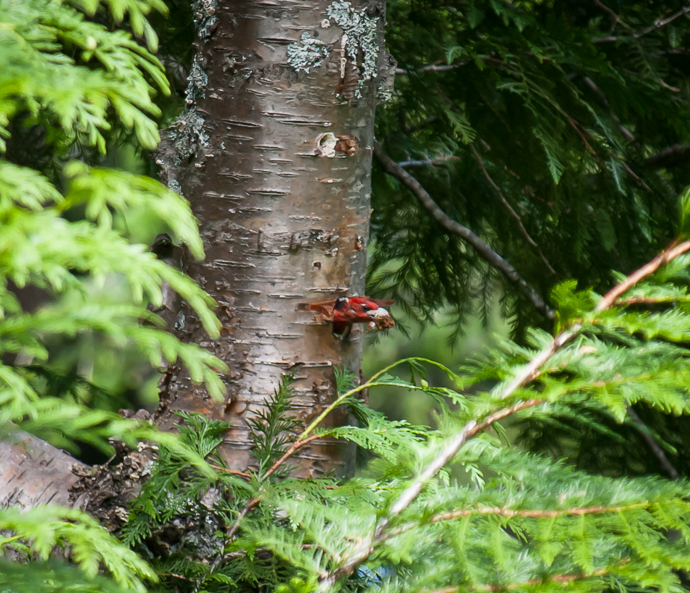
Kim has located a nest near one of the trails on the grounds of the North Cascades Basecamp which she and her husband own. It includes a male Red-breasted Sapsucker and female Red-naped Sapsucker. I was lucky enough to have her show me the nest in a water birch tree. We observed both birds going to and from the nest, catching bugs and visiting sap wells before returning to feed young. On one departure I observed that the male was carrying a fecal sack. These birds like to keep their nest tidy.

Now I don’t do a lot of bird photography. I love to bird and I love to make images however it’s often challenging for me to both well. I lack the really long telephoto lenses to get the extreme sharp close-ups so my bird images are mostly for documenting a particularly striking or unusual bird or one that is otherwise noteworthy. I thought this situation was noteworthy and worth recording.

Red-naped Sapsucker female

Jun222013_0047

Red-breasted Sapsucker male

Jun222013_0076

The landing – feet first

Jun222013_0056-2

They always looked out of the cavity in all directions before exiting.

Jun222013_0062

Sapsuckers make ‘wells’ in trees to get to the sap. They are evenly spaced in neat rows and the birds return to them year after year. Hummingbirds will also sip from the sap wells. I saw a Black-chinned hummingbird at this tree.

Jun222013_0072

Yesterday, other birders observed that the birds were catching bugs; taking them to the sap wells and dipping the bugs before taking them to the youngsters in the nest. Sort of like coating cold cereal with sugar so the kids will eat it.

Jun222013_0073

Here is the female rocketing out of the hole.

Jun222013_0094

And here, the male is carrying a fecal sack away from the nest.

Jun222013_0102

And there he goes!

Jun222013_0103